
Episode 1 · 3D modeling & printing
Race the Ghost: a board game built in a weekend, with a Crew of AI
A 3D-printed Halloween game for my kids, published on MakerWorld. The printing was the familiar part. Everything around it changed.
The build
One brief, four personas, eight steps
I wrote one task in Crew: a simple Halloween game, printable in under 15 hours, AMS-friendly. The personas handed the work to each other. I stayed on the printer and the playtest.
Brief
One task: simple game, ≤15 h print, 4 colours.
MeGame design
Three concepts, one picked. Rules, board, learning goal.
Game DesignerCAD
Parametric OpenSCAD, 19 STLs, print guide.
3D Model DesignerFix & print
Simplified the model, sliced, printed the set.
MePublish
Listing on MakerWorld, Halloween design contest.
MePlaytest
Played with the kids. Rules changed. Game renamed.
Me + kidsRules sheet & video
A4 sheet and a 109 s how-to-play, both EN + HE.
Game Designer · Motion DesignerTrack
Daily MakerWorld stats, logged without asking.
SecretaryWhat AI changed
Three things I would never have done by hand
Not the modeling. The parts of a project that usually get skipped because the printer is already running.
1 · The branding around the model
A how-to-play video, a picture-led rules sheet, and a listing image. In two languages. For a game that took one weekend. Before, a model went up with three photos and a paragraph.
How it was made
The Motion Designer persona wrote a storyboard, I approved it, and it rendered the video from code (Remotion), with music and sound effects synthesized in Python. The Game Designer laid out the rules sheet as HTML with inline SVG art, then exported it to PDF. When I renamed the game after playtesting, both were regenerated from the new rules in one task.
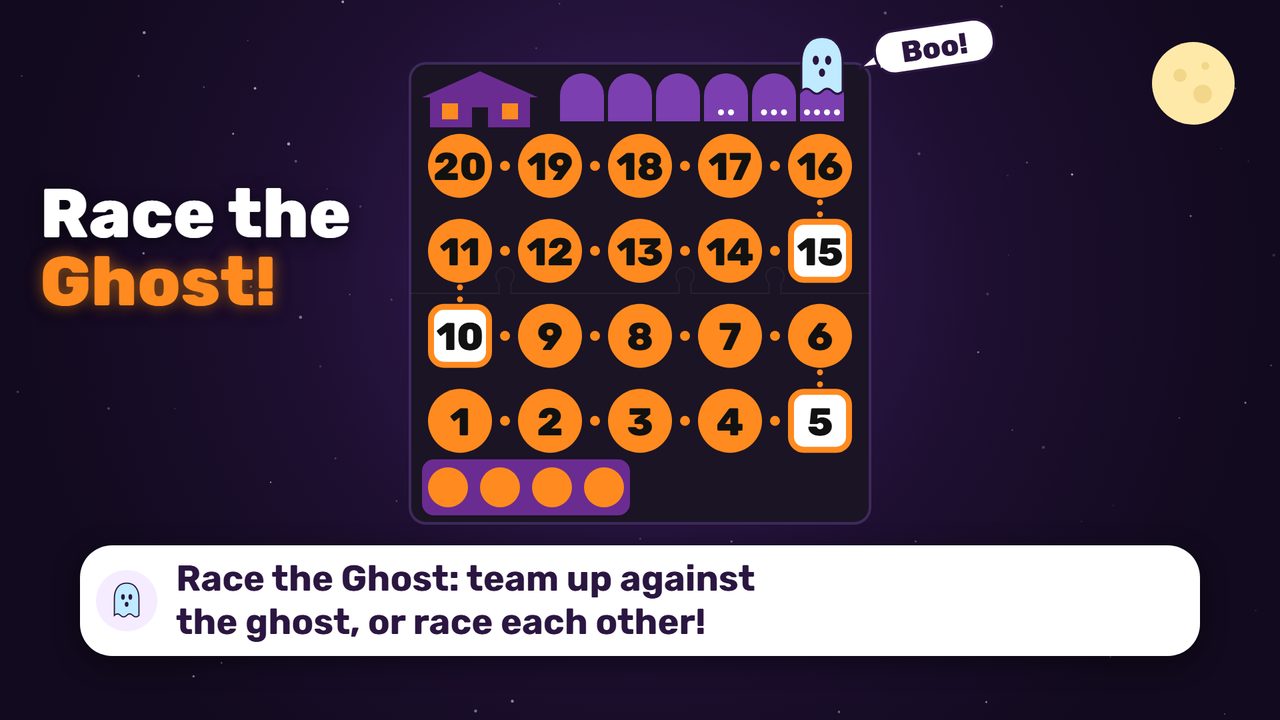
Frames from the 109-second how-to-play video. 18 scenes, rendered from a JSON timeline.
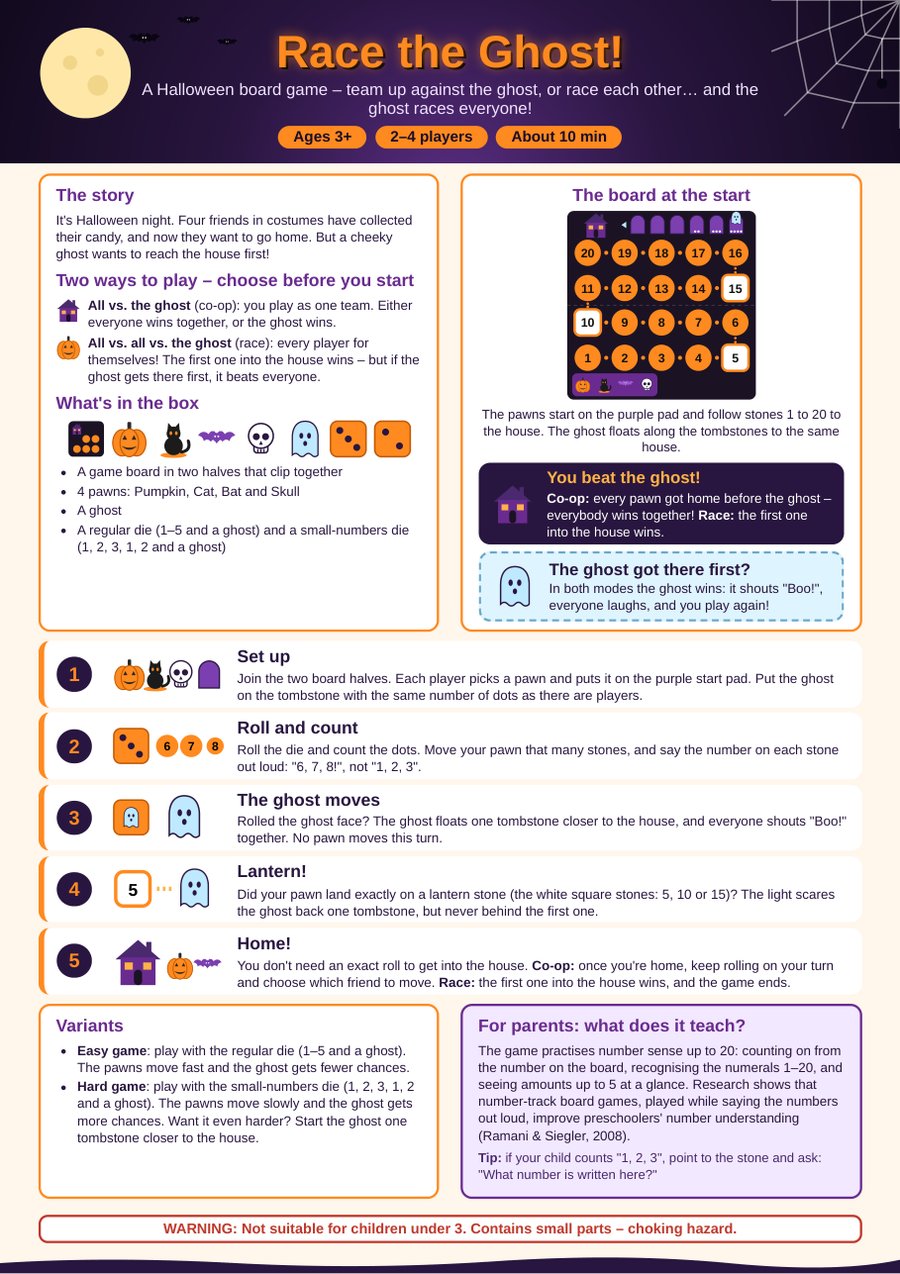
One A4 page, picture-led, with the small-parts warning and a note for parents on what the game teaches.
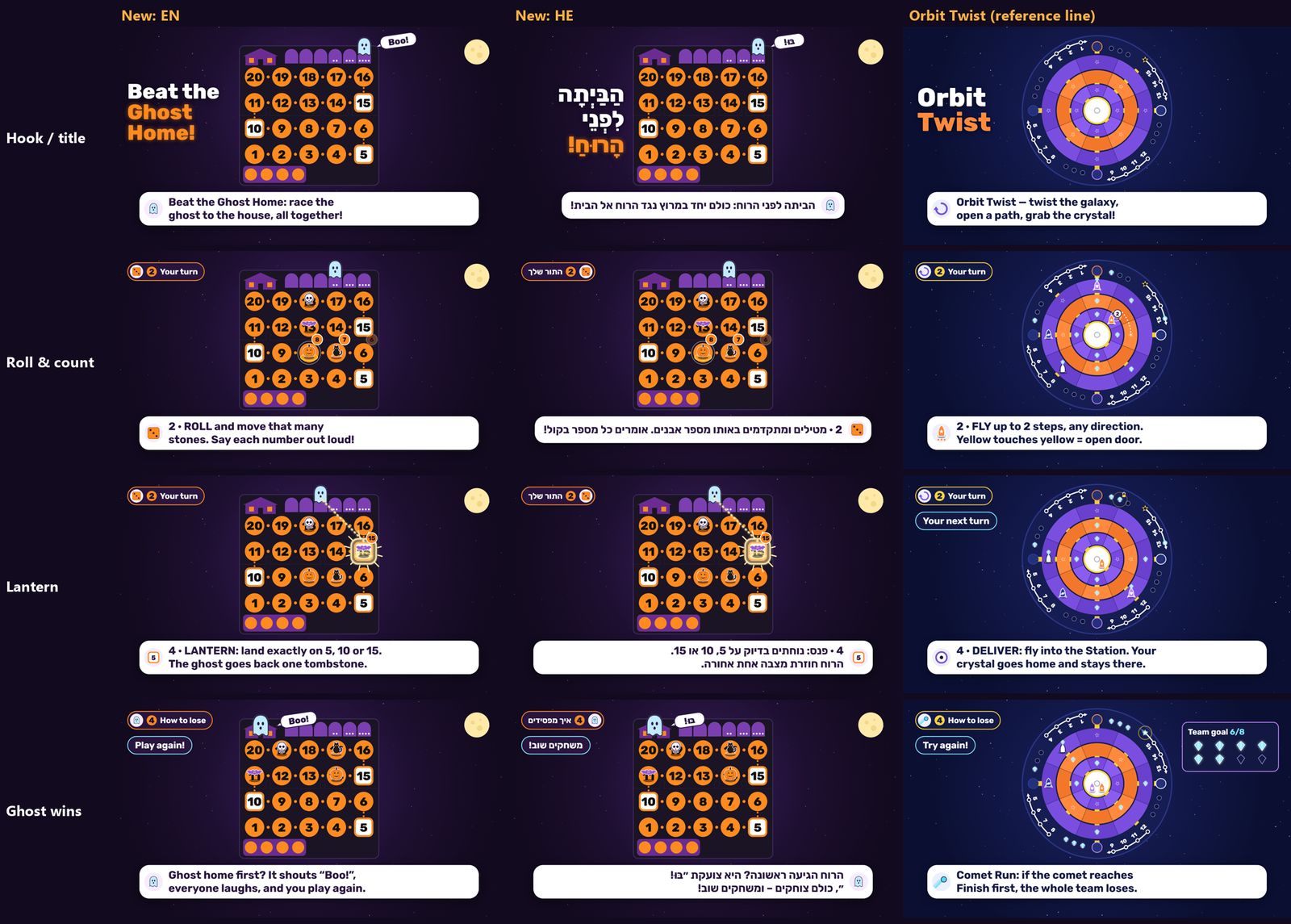
The storyboard I approved before any rendering. Left: English. Middle: Hebrew. Right: the reference style from a previous game.
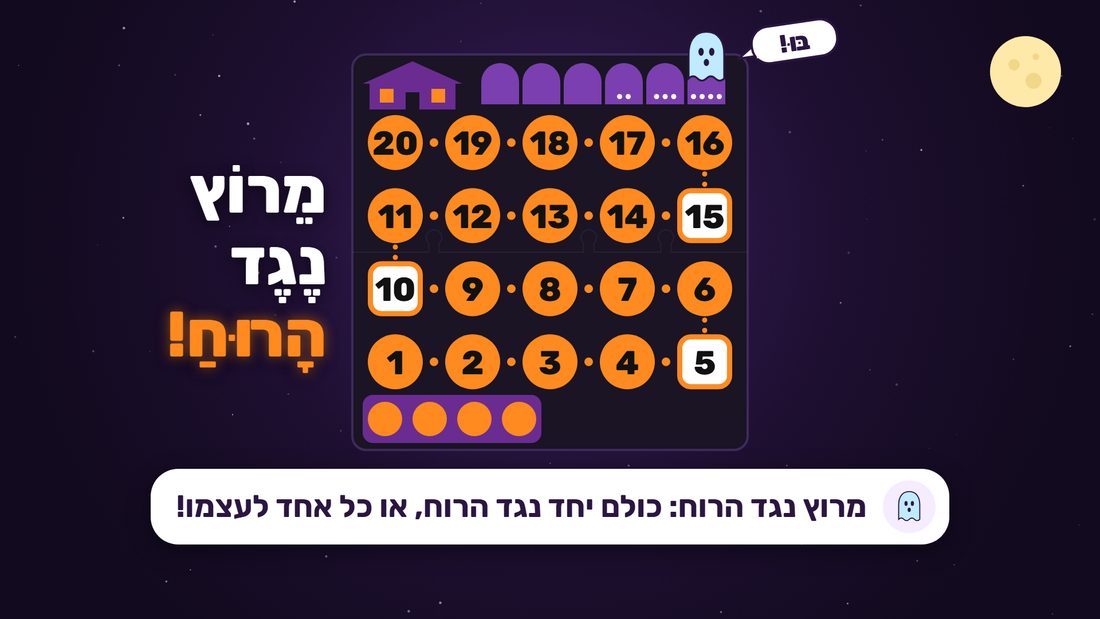
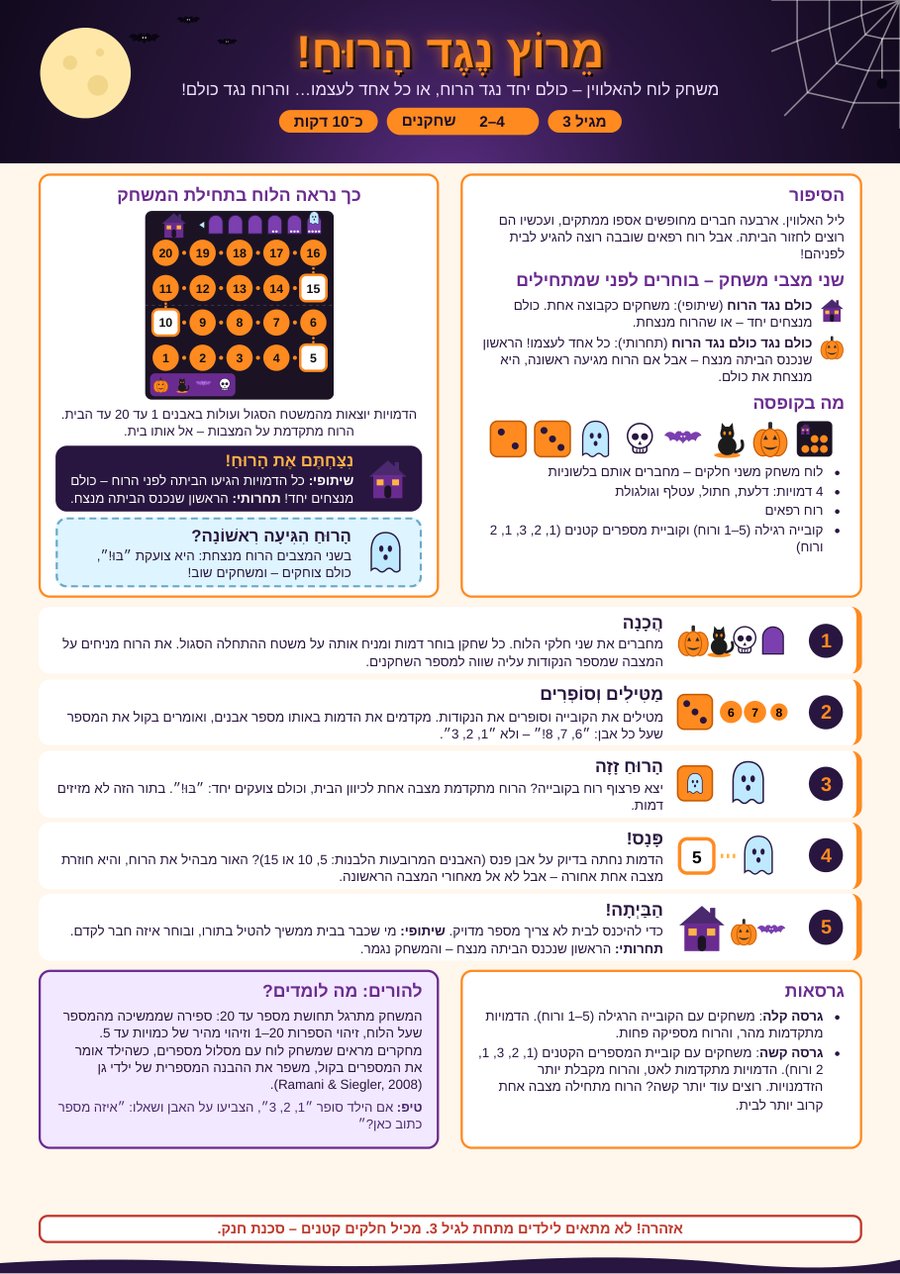
Same assets in Hebrew, right to left, with vowel marks on the title for young readers.
2 · Probability testing
Is the game winnable, and not too winnable? Instead of guessing, the rules were played 3,000 times per setup in a simulation. Target: kids win 70 to 80 percent of games. Easy enough to be fun, hard enough that the ghost matters.
What the simulation showed
- With the regular die the kids win 81 to 86 percent of games. Slightly generous, which is right for ages 3 to 6.
- The small-numbers die drops that to 64 to 74 percent and makes a longer game. That is the "hard mode" in the rules.
- Starting the ghost one tombstone closer costs the kids about 5 to 10 points. That became the "even harder" variant.
Kids' win rate, co-op mode
3,000 games per bar. Ghost starts on the tombstone matching the player count. Hover a bar for game length.
3 · Exploring ideas
I asked for "a simple Halloween game". I got three concepts scored on fun, learning value and print cost, with a recommendation and the reasoning. I picked in a minute. On my own I would have built the first idea that came to mind.
Why the co-op race won
Everyone wins or loses together, so the youngest never loses alone. The numbered track doubles as a counting exercise, and the lantern stones on 5, 10 and 15 give a reason to count carefully. The other two were kept as possible expansions.
Beat the Ghost Home
Co-op race on a 1–20 track. Reach the house before the ghost.
Candy Cauldron
Roll, collect candy tokens into a ten-hole cauldron. First full cauldron wins.
Spooky Memory
24 printed picture tiles, matching game.
Where I stepped in
Two places the AI still needed a human with a printer
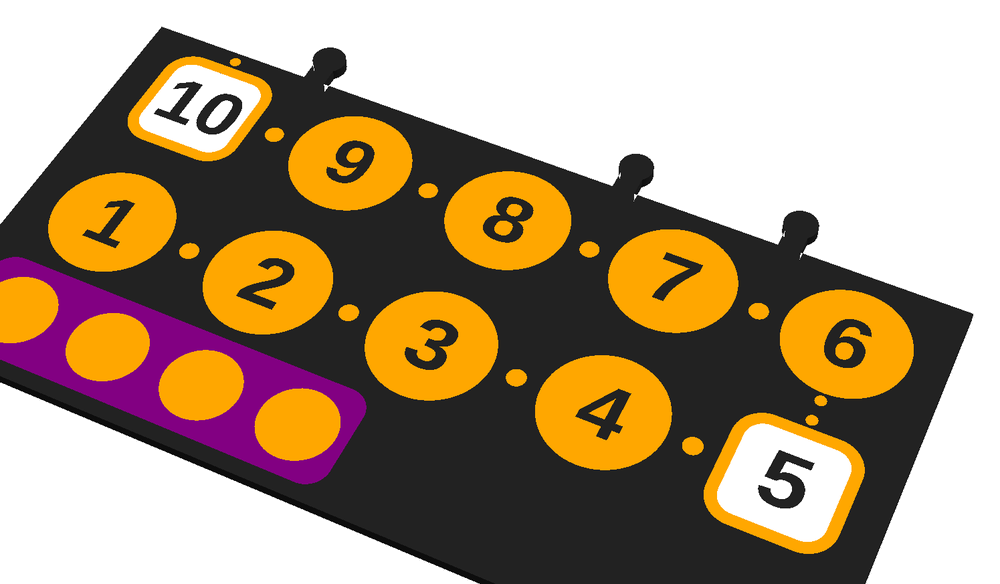 Saved ~2–3 h of printing
The model printed fine. It printed slowly.
The 3D Model Designer did exactly what it was asked: a four-colour board with every numeral and stone as a 0.6 mm inlay, one STL per colour. Clean, parametric, no supports. But multi-colour top layers mean filament swaps and purge on every layer of the colour band.
What it should have said: "paint the numbers". I modified the model by hand and cut around two to three hours off the print. An AI will optimise for the constraint you wrote down, not for the one you forgot to mention.
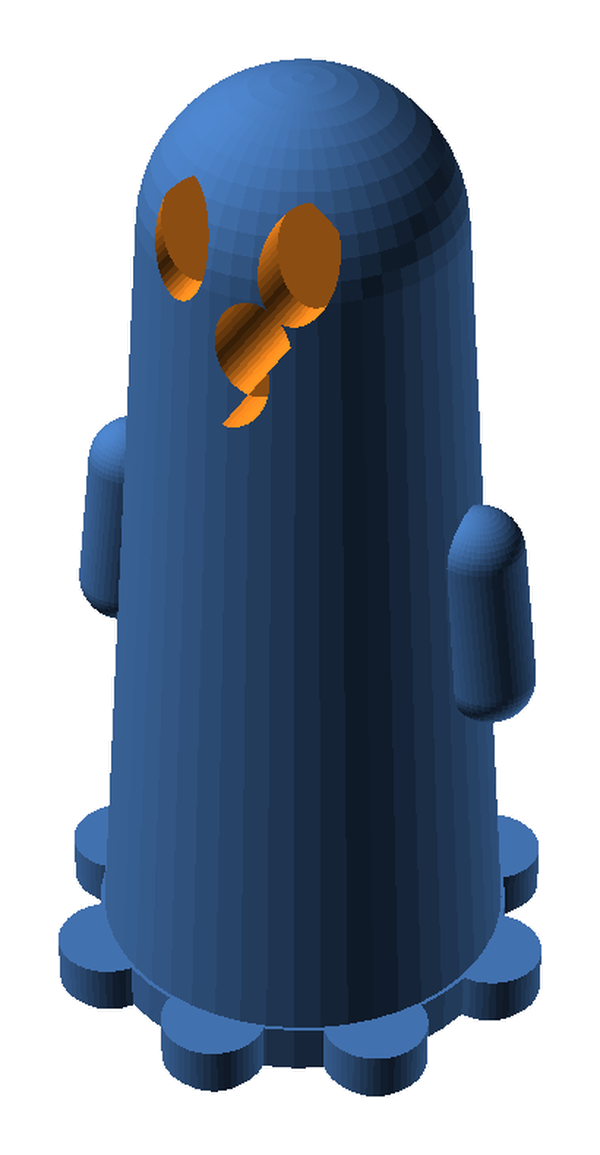 Found by playing, not simulating
Simulation finds imbalance. Kids find holes.
The rules read fine on paper and won 3,000 simulated games. Playing them at the kitchen table is what turned "Beat the Ghost Home" into "Race the Ghost": a second, competitive mode for the older kid, both dice the same colour, the age rating lowered to 3+.
The more complex the game, the more this matters. A simulation checks the rules you wrote. A four-year-old checks the rules you meant.
My project rating in Crew: 5 of 5. "The result was excellent. The only problem was that the 3D model designer created number plates instead of telling me to paint the board."
Before / Now
The same project, two ways
Flip the switch. Same hobby, same printer, same kids.
- IdeaThe first idea that came to mind, and straight into CAD.Three scored concepts with a recommendation. Picked one in a minute.
- RulesExplained out loud at the table, slightly differently each time.A design document, a one-page illustrated sheet, EN and HE.
- Balance"Feels about right." Adjusted after the kids got bored or frustrated.3,000 simulated games per setup before the first print. Variants tuned from the numbers.
- ModelEvenings in CAD, measured and tweaked by hand.Parametric OpenSCAD from a spec. Still needed my hands for print efficiency.
- TutorialNone. Maybe a photo of the rules on a napkin.A storyboarded, captioned video in two languages, rendered from code.
- PublishingThree photos and a paragraph, then forget about it.Listing text, banner, video, and a daily stats log kept by the Secretary persona.
- My jobEverything.Brief, decisions, printing, playtesting. The parts that need a human.
By the numbers
The print set, and the first ten days on MakerWorld
The print set
9 plates · 4 AMS colours + glow PLA · estimated 9.4 h| Plate | Part | Colours | Est. time |
|---|---|---|---|
| 1–2 | Board, two halves with puzzle tabs | Black, orange, purple, white | 5.0 h |
| 3–6 | Pawns: pumpkin, cat, bat, skull | Two colours each | 2.4 h |
| 7 | Ghost | Glow-in-the-dark PLA | 0.8 h |
| 8–9 | Dice: regular and small-numbers | Orange | 1.2 h |
Board 230 × 230 mm assembled, 3 mm thick. No supports anywhere. Times are the spec estimates before my edits.
MakerWorld, 17 to 26 October 2026. Logged daily by the Secretary persona.
Takeaways
What I'm taking to the next build
"Under 15 hours" got me a 9.4-hour set. "Minimise colour changes" would have saved the evening I spent fixing the board.
Video, rules sheet, listing. That is what AI made cheap, and that is what people see first on MakerWorld.
A simulation told me the odds. The kids told me the game needed a race mode. Both were right.